Educate Yourself About Bears.
The Podcast (video added) interviewer from Colorado asks many great questions about bears and people being active in areas where there are bears. 48 minutes
How Bears Become Nuisances
 Bears will travel more than 100 km to a known food source, such as a berry patch or a stand of beech trees. Bears are highly intelligent and will learn where other food sources can be found and seek them out. They can easily learn to re- visit your back-yard or campsite once they have determined that food can be found there. The majority of bear problems occur as a result of improperly stored household garbage. Bears quickly learn to associate human residences and campsites with a readily available food source.
Bears are also attracted to pet food that is left outdoors, bird feeders, barbecues, composters, fruit trees, beehives, sweetcorn and grain fields. Garbage dumps provide a concentration of readily available food that often attracts bears. Bears lose their natural fear of humans through repeated exposure to people in areas where food is intentionally or unintentionally provided. 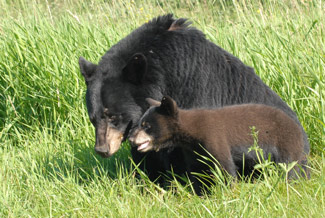 In such cases, conflict with humans is inevitable; bears may even become destructive or dangerous. Such bears are often destroyed because they have become a “nuisance” or are perceived as a threat to human safety. That is why you should never intentionally feed bears or place food to attract wildlife to your yard for viewing.
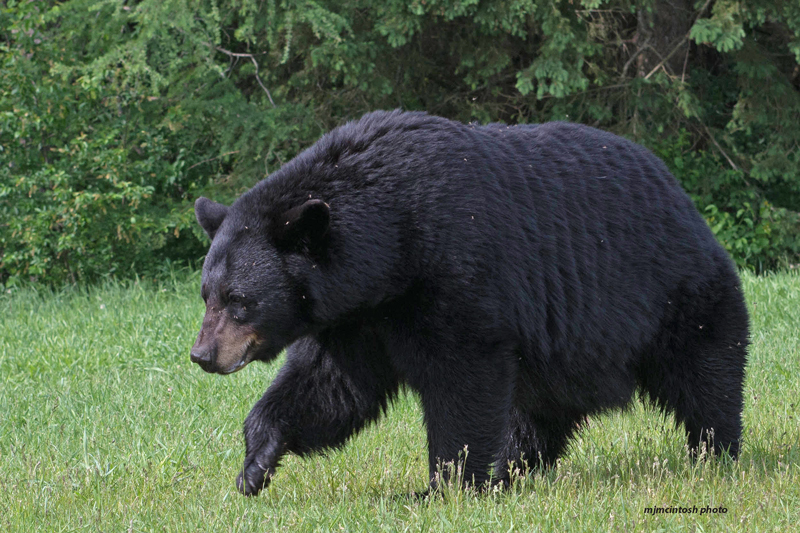
Credits: Ontario Ministry of Natural Resources, Dr. Martyn Obbard. Photography – Mike McIntosh
People & Bears Can Co-Exist
People need correct information about bear behaviour and their biological requirements. This allows an appreciation for these animals and encourages the will to coexist. People and bears can coexist. We just need to know more about the bear as it really is, not the bear that exists in our head. Learn more at Wise About Bears.
Bears are very strong and quick. Bears have the capability to be dangerous, however the possibility of a bear harming people is overstated . Bears have the power to inflict great damage but for some reason they exhibit tremendous restraint when dealing with people. Bears that allow themselves to be seen by people don’t tend to be a threat to human safety. This is documented. In addition, so called nuisance bears have not attacked and killed anybody that there is record of. Some times a bears nervous behavior is misinterpreted for actions of aggression and the bear is unfairly dispatched (killed).
Education about bear behaviour and changing human behaviour will reduce human/bear conflicts. Education will also reduce the need to live trap and relocate or worse still, kill the bear. Relocation of a bear should be a last resort to solving a people/bear conflict. A good reason for relocating a bear is when human activity is too hard to manage. Examples are parks, schools and areas where the number of people reduce the opportunity to encourage the bear to move on by removing the attractant (ie-peoples food, bird seed, food for pets).

Conflict Resolution – Human and Bear – Nuisance Bears and Relocation
When other options have been exhausted such as people removing attractants, relocating a bear is a possible next best alternative. When relocating the bear is deemed necessary, and after consulting with MNRF staff, a bear may be live trapped and moved to a different location. I believe that relocating a bear with a full stomach greatly reduces the chance of that bear homing immediately. When relocated to an area featuring good bear habitat, the released bear (not thirsty or hungry) is less likely to return. We hope the animal is content enough to explore, rather than thinking only of a bellyache and quickly returning to the area it knows it will find something to eat. Certain individual bears will return. The ones that may possibly return are usually older females and males. It is the young bears, the sub adults, that are most likely to be involved in human/bear conflicts. If a young bear is relocated due to necessity, the immediate return of the young sub adult is unlikely. My experience is that approximately one in ten relocated bears (all ages) return to the area of conflict. This is based on a personal project involving the live trapping and relocating of thirty three bears away from a municipal landfill belonging to the Town of Huntsville. The bears were ear tagged. Of the thirty three, three of the bears were caught for a second time and moved away from the area again.
I personally will only consider moving females with cubs when all other options are exhausted.
A bears well being is considered as well as people’s fear and concerns.
Please be aware that the work we do, as described above, would not be possible without the cooperation of the Ontario Ministry of Natural Resources and Forestry. They supply an authorization permit annually. Their cooperation is appreciated.- Mike McIntosh
Credit: Mike McIntosh